Monday, January 16, 2012

Our Holiday in England (Part 4 of 4): Hastings, Stonehenge, & Stratford-Upon-Avon

We awoke in Hastings to find Peter feeling much better and all of us hopeful for a less stressful day.  Our first stop on the itinerary:  the site of the Battle of Hastings.  We were a little too ambitious, as the castle did not open until 10 am.  We found a little tea shop nearby, just opening its doors, and stepped inside for a snack to warm us.  We looked at the menu and excitedly ordered "Cream Tea to go, please!", thinking we'd be served a cup of hot tea with cream...sounds logical, right?  The waiter smirked a little and asked "Do you know what Cream Tea is?" as he undoubtedly interiorly laughed at the silly Americans.  I sheepishly mumbled "Um, no..."  

So, to save you the embarrassment when you visit a tea shop in England, I'll fill you in.  Cream Tea refers to a whole pot of tea served with scones and pastries.  It'd be something that you would order if you were going to sit down and chat with your grandmother for several hours- not something you'd order "to go". 


The quaint little tea shop in Hastings

Hot tea with cream : )

After our tea shop education, he made us a cup of hot English tea, with cream added, in a "to go" cup.  Mmmm...it was worth all of the confusion.

Once the clock hit 10, we walked across the street to the entrance of "Battle Abbey."  Battle Abbey was built on the Battlefield of Hastings.

The Battle of Hastings was a major event in Western history.  Before the death of the English king Edward the Confessor (who also happens to be a Roman Catholic Saint buried at Westminster Abbey in London), Edward had promised the throne of England to his cousin William of Normandy.  However, on his deathbed, Edward changed his mind and decided to give it to a member of the most powerful family in England, Harold Godwinson.  Harold was crowned king and William took this as a declaration of war--he planned to invade England and take the crown he believed was rightfully his.

William and his Normans (decendants of the Vikings who had settled in northern France) crossed the English Channel with a fleet of 700 ships and invaded England in 1066.  There has never been another successful invasion of England since.

William made his way north and met Harold and the English army on a plain near the town of Hastings.  Nine hours of deadly combat followed.  As the English began to sieze the upper hand, an Norman arrow struck King Harold in the eye and he died soon after.  The English forces soon began to collapse and William "the Conquer" took the field.

William then made his way to London where he was crowned on Christmas Day, 1066 as King William I of England.  This cornation is the first recorded English coronation to take place in Westminster Abbey where subsequent English coronations have taken place up until the present day.


Later, in 1070, Pope Alexander II ordered the Normans to do penance for killing so many people during their conquest of England. So William the Conqueror vowed to build an abbey where the Battle of Hastings had taken place, with the high altar of its church on the supposed spot where King Harold fell in that battle. 

Other than being the last successful invasion of England, this battle also marked the beginning of a major change in the English culture and language.  The invading Normans were French-speakers and their language began to mix with the very Germanic  language of the English.  This is why many words in the English language have French roots, such as:  servant, acquaintance, and companion.

Visiting this historic abbey and the battlefield was very interesting.

The medieval gate house to "Battle Abbey"

Sarah and Peter standing where the English Army lined up on the Battlefield of Hastings


After exploring Hastings, we settled back into our warm car.  Though Peter was doing much better, we didn't want to over-do it, and a little drive allowed him to rest a bit. 

Soon, we arrived at Stonehenge!  What a cool experience!  Stonehenge is surrounded by farm fields, sheep, and tourists.  The highlight of the day (possibly even the trip) for Peter were the fluffy white sheep grazing near Stonehenge. 


Baaa!


After another two hours in the car, we arrived at Stratford-Upon-Avon at dusk.  Stratford-upon-Avon was the birthplace of William Shakespeare and the present day site of his tomb.  Unfortunately, Holy Trinity Church where Shakespeare is buried was closed to visitors an hour before we arrived.  However, Dan got some pictures of the beautiful church and its surroundings at dusk.


We had planned to spend more time exploring this famous town, but we ended up just snapping some photos and settling into our hotel for an early bedtime for Peter.


The next morning we drove to London and flew back to our home in Turkey...it had been a whirlwind trip, but it was definitely nice to go to a place where EVERYONE spoke English!  :)


Our Holiday in England (Part 3 of 4): Canterbury

After a fairy tale-esque day in London, we were jolted back into reality the next morning as we awoke to find Peter under-the-weather.  I can't think of anything worse than traveling with a toddler with the flu.  Cue:  mom guilt.  Cue:  parental worrying.  Cue:  stress.  Unfortunately, we couldn't afford another night in the expensive city of London, nor could we afford to cancel the car rentals and hotel reservations waiting for us.  So, we packed up our suitcases, packed up our little man, and took a cab to the car rental office. 

We started to feel more hopeful as we got settled into our fancy automatic rental that cost us an arm and a leg (neither of us felt confident enough to try driving a manual in a foreign country on the opposite side of the road and car...therefore, we had to spend more on an automatic).  We drove down the road to Canterbury as Peter rested in his car seat. 

Upon arriving in Canterbury, we discovered that the quaint little town had been overrun with relatives and guests attending a university graduation in Canterbury.  We grumbled as we searched in vain for parking as we drove through the confusing, narrow streets.  Finally, we found a spot and breathed a sigh of relief.  Peter was starting to improve, though he was in no shape for sightseeing.  Dan and I took turns watching Blues Clues videos on our portable DVD player in the car with Peter while the other hopped out to take a quick tour of the Canterbury Cathedral. 

The Canterbury Cathedral is the site of the martyrdom of Saint Thomas Becket.  Saint Thomas Becket was the Archbishop of Canterbury from 1162 until he was murdered in 1170 inside Canterbury Cathedral.  Becket had a conflict with King Henry II of England over the rights and privileges of the Church.  King Henry II, disgruntled about Thomas excommunicating bishops who supported him, said in front of some of his followers:  "Will no one rid me of this turbulent priest?"  This statement was interpreted as a royal command and four knights, Riginald FitzUrse, Hugh de Morville, William de Tracy, and Richard le Breton set out to confront Thomas.  The knights arrived at Canterbury Cathedral and ordered the archbishop to go to Winchester to account for his actions--Thomas refused to go with them.  The knights left, picked up their weapons that they had placed outside the cathedral, and rushed into the cathedral for the killing.  They entered the church as the monks were chanting their evening vespers, found Thomas, and murdered him with their swords in the church. 

St. Thomas Becket was seen as a martyr for the faith and was canonized just two years after his death.  His shrine at Canterbury Cathedral became a major shrine of pilgrimage and many miracles occurred through his intercession.  Many pilgrims from London would journey 60 miles to visit the Saint's tomb.  The famous English work, The Canterbury Tales written by Geoffrey Chaucer in the 1300s, contains fictional tales told by fictional London pilgrims as they made their 60 mile journey from London to Canterbury (the same path we drove on our own pilgrimage!).  It was amazing to be following in the footsteps of so many pilgrims throughout history!


The charming little town of Canterbury


Canterbury Cathedral


These are the Pilgrim Stairs leading up to the place where St. Thomas Becket's Shrine (tomb) was. Medieval pilgrims would climb these stairs on their knees.  The stone stairs are worn from the numbers of pilgrims who climbed them.


This candle burns where the shrine of Saint Thomas Becket stood from 1220 to 1538 when it and St. Thomas' bones were destroyed by order of King Henry VIII (Henry had little respect for a Saint who had defied an English king).  Near the candle, you can see grooves in the stone floor worn down over the centuries by kneeling medieval pilgrims...incredible.


The main altar

After visiting the cathedral, we drove a little farther down the road to Hastings.  After a long day with a sick child in a foreign country, I nearly cried tears of joy when we pulled up to our hotel.  Rather than a little European B&B, we arrived at a big chain hotel, very similar to a Holiday Inn in America.  And across the street from our hotel, like a beacon in the night, stood the glowing Golden Arches...yes, that's right, a Mc Donald's!  Now, let me clarify; I love little European B&B's and I'm not a huge fan of Mc Donald's.  BUT, when living and traveling in a foreign country gets stressful and tiring, there is nothing like a little comforting taste of home.

 Our hotel had a bathtub...an actual bathtub (rare in the European/Middle Eastern hotels we've found)--God bless America...and hotels that remind us of America.  The bath perked Peter right up and soon he was clean and acting like himself again.  What a blessing.  Dan picked up Mc Donald's for us while Peter stuck with 7-Up and a bagel.  Dan and Peter relaxed and watched a little more of his Blues Clues video before bed.  The whole Beaudoin crew was fast asleep before 8:00 pm, a much needed rest after such a day.


Sunday, January 8, 2012

Our Holiday in England (Part 2 of 4): Afternoon in London


After our picnic lunch, we snapped some photos of Westminster Abbey (which was not open for visitors until later on that afternoon) and then set off for an afternoon of sightseeing.  London is such an incredible city.  There is so much to see.  It was easy to ignore the hours and hours of walking because we were so distracted by the impressive sights and sounds of the city (and it was easy for Peter to ignore the hours of walking because he took a long nap in the stroller later that afternoon--hooray!).  And somehow, though it is a great big city, it doesn't feel stressful or chaotic.  It remains charming and exciting.

Westminster Abbey

We strolled past Big Ben again and headed across a bridge over the River Thames.  From the bridge, we caught an impressive view of the London Eye; a gigantic Ferris wheel that offers a spectacular view of the city. 

The London Eye

We then trekked through the streets of London in search of Shakespeare's Globe Theater.  Shakespeare's Globe was quite a hike from the Westminster Abbey, but again, the sights of London--St. Paul's Cathedral and Christmas markets--helped distract us from the long walk.  We finally found it, stopped inside to see the ticket office and lobby (and, of course, bathroom and gift shop!)  and then snapped some pictures of the outside.  The modern day Globe Theater is a replica of Shakespeare's Globe Theater from the 1600s and is located near the site of the old theater.  It's hard to imagine that the Shakespeare plays that I read in high school were first acted out in a theater very much like this and not far from it!

The Globe Theater

Just around the corner from Shakespeare's Globe Theater was THE London Bridge!  London Bridge was very simple and unassuming, but my historian husband informed me of its rich history.  Dan said that there has a been a bridge on this site since close to London's founding by the Romans in the First Century...the Romans called the city "Londinium" which is where the name "London" comes from.  Dan also said that the familiar nursery rhyme "London Bridge is Falling Down" may refer to an event in the year 1014 when, in an effort to assist the Anglo-Saxons in a war against the Danes, the Norwegian prince Olaf tore down London Bridge and divided the forces of the Danes on either side of the River Thames.  The bridge was later rebuilt and, over time, shops and homes were built on top of it.  The road going down the center of the bridge was so narrow that the city of London attempted to control traffic on it by regulating that north bound persons/carriages/horses/cargo must use the left side of the road and southbound traffic must use the right side of the road...it is believed that this tradition is the reason why the British drive on the left side of the road!  Finally, the south side of London Bridge also displayed sights that were meant to deter traitors to the Crown.  Beginning with William Wallace (the Scottish rebel whose story is told in the movie Braveheart) in 1305 and continuing for another 355 years, the heads of traitors were placed on spears on the south end of London Bridge.  Among other famous individuals to be displayed in this gruesome manner were St. Thomas More and St. John Fisher who were ordered executed by Henry VIII for their fidelity to the Roman Catholic Church.

We walked across the now humble bridge that has seen so much history over the years.

Dan posing in front of London Bridge


Tower of London

After the Tower of London, we hopped in a cab and drove back to Westminster Abbey to tour the inside before it closed for the day.  What an incredible church!  Peter conveniently fell asleep, enabling us to soak in every beautiful detail and every nugget of history in the massive church.  This church was originally a Benedictine Abbey before the Protestant Reformation.  The coronation of William the Conqueror as King William I in 1066 was the first documented crowning of an English monarch in Westminster Abbey...monarchs have been crowned here ever since.  There are also many tombs of important Britons...we saw the tombs of Queen Elizabeth I, King Edward I ("Longshanks" of Braveheart infamy), Queen Mary I ("Bloody Mary"), Saint Edward the Confessor (a King of England and father of William the Conqueror), Geoffrey Chaucer (author of The Canterbury Tales), Charles Dickens (author of A Christmas Carol, David Copperfield, Great Expectations, A Tale of Two Cities, and Oliver Twist), Rudyard Kipling (author of The Jungle Book and the poem "Gunga Din"), Isaac Newton, and Charles Darwin.  And, of course, I couldn't resist imagining what it'd be like to attend a royal wedding inside of these grand walls!


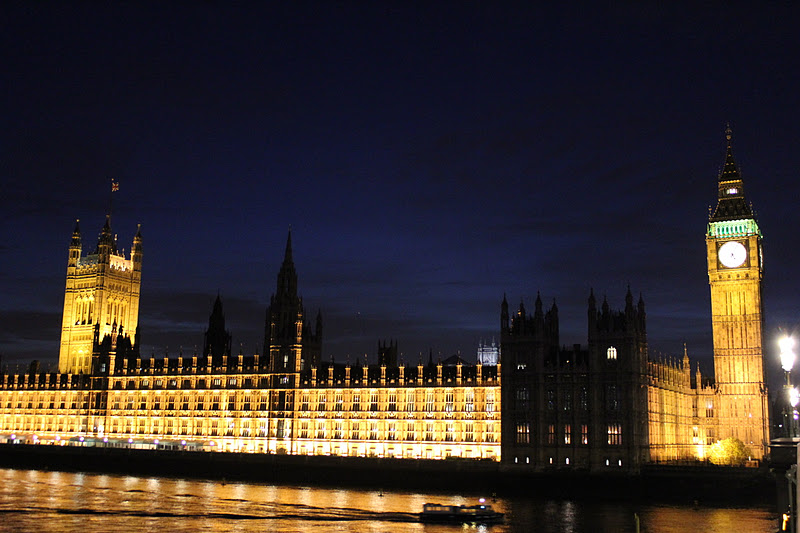
After our tour of Westminster Abbey, we walked back over the Thames in search of dinner...our Thanksgiving Dinner.  London during the day is impressive.  London at night is absolutely breathtaking.  The light that shone from the buildings danced on the waves of the river below.  We almost expected to see Peter Pan fly across the sky as we gazed up at Big Ben and the enchanting skyline. 


We stumbled across a Christmas market during our stroll. There were little stands with food, gifts, and entertainment along the street adorned with twinkling lights. We soaked in the sights and sounds of Christmas, something we've greatly missed after living in a Muslim country for over a year.  We then stepped out of the chilly night air into a little British pub for dinner. 


Peter and I relaxing together...Peter sipped a glass of apple juice and mommy had some ale. 


We finished our grand tour of London with a tasty Thanksgiving feast: fish and chips (followed by bread pudding)!  Yum! 


Next stop, the Tower of London! The Tower of London was originally built by William the Conqueror who claimed the throne of England in 1066 after defeating his brother Harold at the Battle of Hastings. Despite its enduring reputation as a place of torture and death, only seven people were executed within the Tower before the World Wars of the 20th century.  In the First and Second World Wars, the Tower was again used as a prison, and witnessed the executions of 12 men for espionage.  St. Thomas More and St. John Fisher were executed outside of the Tower on Tower Hill, but they were buried in unmarked graves in the churchyard of St. Peter ad Vincula inside the walls of the Tower of London.

Wednesday, December 14, 2011

Our Holiday in England (Part 1 of 4): Waking up in London

We just returned from "going on holiday" to England!  We hopped on an evening flight from Turkey on Wednesday, took a London black cab to our hotel, and woke up in London on Thanksgiving Day.  We started our tour of London bright and early; we had lots to see and only one day to see it!  We were blessed with perfect weather: brisk, but sunny and bright clear skies.  A perfect day for a tour of London by foot! 

Our trip to England was rejuvenating from the moment our plane landed and we heard English being spoken by the customs officer.  Though we do have the comforts of America on our little base in Turkey, outside of that one mile radius encircled by a barbed wire fence is a culture starkly different from our own.  To be able to speak English and blend in while traveling was a breath of fresh air.  We haven't been back to America in almost 1 1/2 years, so going to England gave us the little taste of home we needed.

Of course, even England is not completely  like "home" for us.  As we arrived in London, Peter asked Dan to play football with him.  Dan held him by the shoulders, looked into his eyes and told him "Peter...there's no football in England!"  Peter's eyes got big and he said in a deep, worried voice "OH NO!!!"  : )


We walked several blocks to the Westminster Catholic Cathedral (not to be confused with Westminster Abbey).  It was beautiful!  Westminster Cathedral is the largest Catholic Church in England and Wales.  It stands on land originally owned by Benedictine monks who established the nearby Westminster Abbey.  The church is dedicated to the Precious Blood of Jesus.


The inside of the Cathedral was spectacular.  There were several Cardinals buried in the little ornate side-chapels of the huge Cathedral.  Each side-chapel was so very unique and detailed.

The massive Crucifix hanging in the Cathedral Church of the Most Precious Blood in London.

Next we strolled several more blocks to Buckingham Palace!  The palace's flag was waving, which meant the Queen was home!  It was easy to get swept up in the magestic ambiance of the massive palace and wonder what "royal happenings" were taking place inside. 

I told Peter that this was the very big house of the Queen.  He nodded and responded "Crown." 
Peter's background knowledge of royalty consists of:
1.  Seeing pictures in books of Jesus and Mary wearing crowns as King and Queen of Heaven
and
2.  The cardboard crown he wears proudly during our rare trips to Burger King on base
So, I'm not sure who exactly he was picturing as we gazed at the palace, but I could tell the wheels were turning.

Peter paused and then wondered aloud, "Where is she?"  (Sounds more like one word "Where-Izzy?")
I responded, "In her house...maybe she's....having a snack?"  (That was the first "queenly" activity I could think of...)
It worked for Peter.  He confidently repeated "Keen, sack" (Translation: "Queen, snack")


As we explored, I noticed a beautiful street lined with British and Turkish flags leading up to the palace.  Pretty crazy, huh?  There must've been an important political figure visiting from Turkey!


The ornate sculptures, beautiful fountain, and horse drawn carriages surrounding Buckingham palace made it feel even more like we had stepped into the setting of a fairy tale. 


We walked along the pretty autumn tree-lined roads, soaking in the sunshine and the atmosphere.  Peter jumped in the crunchy, colorful leaf piles and grabbed big handfuls of the autumn leaves that covered the ground.  Coming from a land of palm trees, this was a big deal. 

As we turned the corner and entered a charming city park, we saw a little squirrel scamper along the path.  Again, this was a big deal.  We don't have squirrels in Turkey, so this was Peter's first interaction with this kind of little critter.  We took pictures, pointed, and made such a commotion that I noticed a man peer toward us trying to see what treasure we had discovered.  When you're far from home, any little taste of home is so very exciting.  Peter loved the little squirrel and thought it was a hilarious little creature.  He laughed and toddled through the park, searching for more. 

Our morning adventures led us to one of my favorite landmarks in London:  Big Ben.  We approached the big "tick tock, Ben" (as Peter calls it) just as it struck 12:00 noon.  We listenened to the deep ringing of the bell as we walked through the crowds of people bustling through the streets on their lunch breaks.  Our stomachs were growling too.  We grabbed some sandwiches from a little street cafe and ate a picnic lunch by the entrance of Westminster Abbey.  Our morning in London had been full of wonderful sights...and we were only halfway through our day! 


Saturday, December 3, 2011

Islam 101

Living in the Middle East has been an eye-opening experience to say the least.  I am so thankful for the opportunity to temporarily live in a county that is 99 percent Muslim.  Does it have its challenges some days?  You bet.  I definitely miss Christian culture and feel that living in Turkey has helped me to appreciate my Catholic faith more than ever.  But I am also so very grateful for the blessing of our Turkish Muslim friends.  I wish everyone could have a chat with our charming, hard-working gardener, Ilhan; discuss family values and faith over a kabob with our dear friend, Sefer; or encounter some of the hundreds of kind-souled, humble Turks that we have met during our time here. 

Several of my American friends on base have blogs as well.  My dear friend, Sarah, recently wrote a beautiful reflection on her experiences as a Christian in a Muslim country.  I am re-posting her blog to share with you.  I couldn't have said it better myself! 

Islam 101
(from my buddy, Sarah at: http://3tigersinturkey.blogspot.com/2011/10/islam-101.html)
Before moving to Turkey, my only real contact with the Islamic religion was through my TV. Like most other Americans, I watched the planes hit the Trade Centers and burned with anger. Osama Bin Laden became the poster child for Muslims-all of which, I thought, were evil terrorists who hated America.

Then I moved to Turkey, a nation that is 99% Muslim. I became the minority, religiously speaking.

I have been given the opportunity to learn about the Muslim faith from a new perspective, and to erase some erroneous ideas and prejudices I never knew I had. Before I share, let me be clear. I am a Christian. That will never change. In fact, my own faith has deepened during my time here. Learning about another faith shouldn't threaten your own.

I have learned that Turkey is pretty progressive in the Islamic world. It seems to me that the faith is more of a cultural thing and not so much of a personal belief thing. The same, I think, can be said about America. Many people calling themselves "Christians" don't practice the faith necessarily. But they grew up going to church and hunting Easter eggs and celebrating Christmas. So culturally, they are Christians. Get my drift?

When the Call to Prayer sounds 5 times daily, no one stops what they are doing. Things continue as normal. Most women here do not wear a burka or even a head covering. When I have had conversations with some Turks about their faith, they all take a very universalist approach to it. They believe what they believe, but don't make any effort to evangelize anyone. They think that many roads lead to God, and think that what works for them doesn't necessarily work for you. Again, Turkey is progressive, this is not always the case in the Middle East.

I have also learned that the events of 9/11 sicken most Muslims. Some of my friends here on base have actually been given apologies by Turks for what happened. I think I know how these Turks feel. Exactly how I would feel if people viewed me in the same light as radical so-called Christians who bomb abortion clinics or picket military funerals.

So when I return home and see a news story about Muslims, I won't think of Osama Bin Laden anymore. I will think of Seyhun, Hatice, Cigdem, and the many more friends I have made here. I will also think about how learning about anothers faith has the curious effect of strengthening your own. And for that I am really grateful.

Wednesday, November 30, 2011

Our next adventure...


We know our next assignment!
We are thrilled to announce that after our adventures in Turkey, we'll be packing up and moving to...


South Dakota State University!

Dan will be an ROTC instructor
at SDSU in Brookings, South Dakota! 


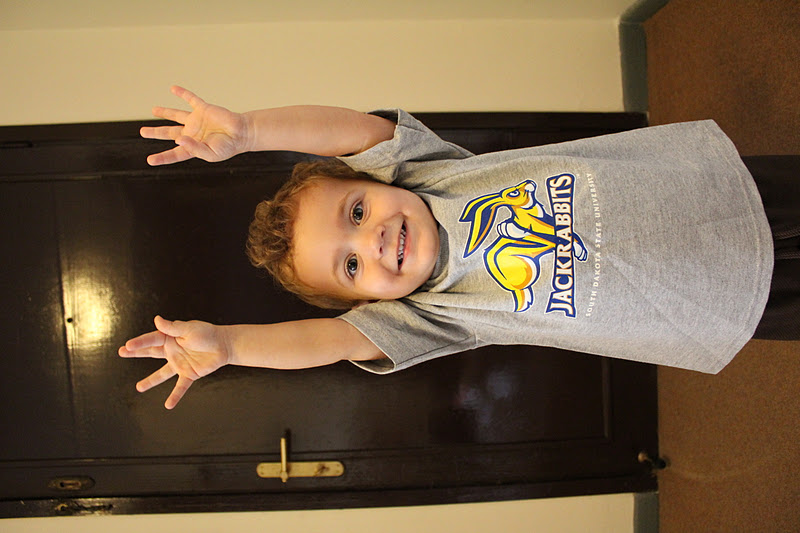
And, yes, Peter is already prepared to fit in with the locals with his snazzy new SDSU Jackrabbits shirt.  My family volunteered to take a road trip to Brookings to check it out for us!  They came back with a glowing report, lots of photographs, and an SDSU t-shirt and socks for Peter.  Here's a little virtual tour of our new home:


The population of Brookings is about 20,000 people. 


SDSU's campus looks beautiful! 
Here's the future home of Dan's office.


My mom taking a stroll around campus.


My family even went to an SDSU football game during their visit! 


My brothers, Ryan and Greg, cheering from the stands.

Dan will start his new job at the end of July 2012.  We are absolutely thrilled to be back in the Midwest; just 3-4 hours away from our families!  We are excited for this next step in God's adventure for us.

Friday, November 11, 2011

Chapel Trip: Tarsus, Heaven, and Hell

We recently joined our Catholic parish for a day trip visiting local sites.  Our first stop was Tarsus, hometown of Saint Paul.  Though this was our fourth time visiting Tarsus, this visit was especially unforgettable.  We were given the priviledge of celebrating Mass in Tarsus inside of St. Paul's Church--a church originally built in the 1700s.  There is a tradition, however, that this church was built on the site of the second Christian Church (after the church in Antioch) founded by Saints Peter and Paul!


We were blessed to have two holy priests accompany us on our trip.  Father Bob is our pastor on base (on the left).  Father Francis (on the right) is a missionary priest that serves the local Catholic Turks in the area.  It's amazing to think of the possibility that both priests were celebrating Mass on the very site that Saints Peter and Paul celebrated Mass almost 2000 years ago!  As Father spoke the words of consecration, I got goosebumps as I imagined Saint Peter speaking those very same words on this sacred ground. 

 
A painting of Saint Paul in his church in Tarsus

The modern city of Tarsus does not have any Christian residents with the exception of two little Italian nuns sent here to maintain St. Paul's Church and arrange for groups to celebrate Mass here. They live in a small, discreet convent across the street from the church. The joyful little sisters invited us to join them for coffee and cookies after Mass.  I can't imagine the challenges these sisters face being the only two Christians in Tarsus.  It was apparent that these crosses did not take away their joy.  They radiated the joy and peace of Christ as they welcomed us into their humble little home.  Though they spoke very little English, they didn't heistate to offer our little "Pietro" another (and another and another...) cookie. 


The Italian nuns put us in their convent's Guest Book!


Our group in the Church of Saint Paul.  The Italian nuns are in the navy blue on the right. 


I have been blessed with wonderful friends in our parish! 
Here are some of us at the Well of Saint Paul. 
It is believed that Saint Paul's home was near this spot and he used this well!

The Beaudoin's at Cleopatra's Gate

Enjoying a tasty Turkish lunch in Mersin!
Next, we visited the Corycian Caves, better known as "Heaven and Hell".  The two caves were formed by underground chemical erosion.  There are many legends associated with these caves. 

The first cave we saw was "Hell".  Fortunately, we couldn't climb down into this cave!  We just peered down into this gloomy deep pit.  It's believed that this was the location that Zeus imprisoned Typhon (from where "Typhoon" storms get their name), a many-headed monster serpent that was the father of the guard dog of Hell (Cerberus). 


Our next stop was "Heaven".  This cave is much larger than "Hell".  We climbed down 452 stairs before we reached the ruins of a Byzantine Chapel dedicated to Mary, built in the 400s AD. 


Inside of the chapel one could see the faint remains of frescos on the ceilings!

Deeper past the chapel is a cave-gorge with an underground river, thought by some to be the River Styx. 


We climbed down, down, down the wet, slippery rocks and clay until we reached the end of the path where the little river quietly trickled. 


It was a fun and busy day!  We went to Heaven, Hell, and back!